Dispelling the Myths
It is time to replace false narratives with truth. Black-owned businesses are professional, innovative, competitive, and essential to our communities and the global economy.
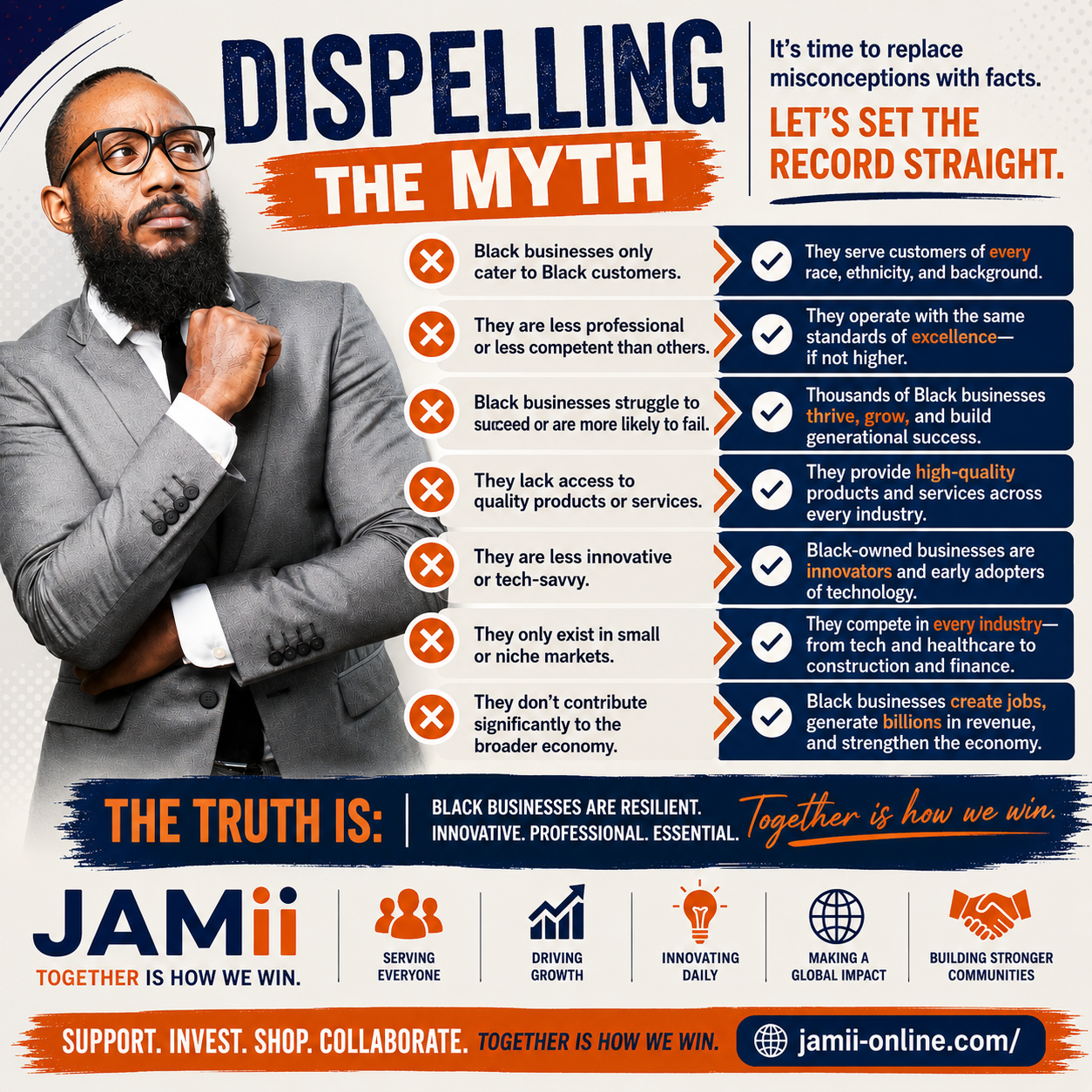
Dispelling the Myth
For generations, Black-owned businesses have contributed to economic growth, innovation, job creation, and community development. Yet many continue to face false narratives that distort public perception and obscure their impact.
This article challenges twenty of the most common myths surrounding Black entrepreneurship and replaces them with facts, context, and reality.
The Story Must Be Told By Us
It is time to dispel the myths surrounding Black-owned businesses. For too long, propaganda and outdated stereotypes have obscured the valuable contributions Black entrepreneurs make to local communities and the global marketplace.
Every community has businesses that can improve. That is true across every race, city, and industry. But the narrative surrounding Black businesses has too often been manipulated to paint a picture of disorganization, poor service, and low professionalism.
That story is incomplete. In many cases, it is simply false. Black entrepreneurs have built companies, created jobs, served customers, developed products, opened doors, and strengthened communities for generations.
We must begin telling our own story.
The Myth Ends When the Truth Is Seen
Together is how we win.
Top Twenty False Narratives About Black Businesses
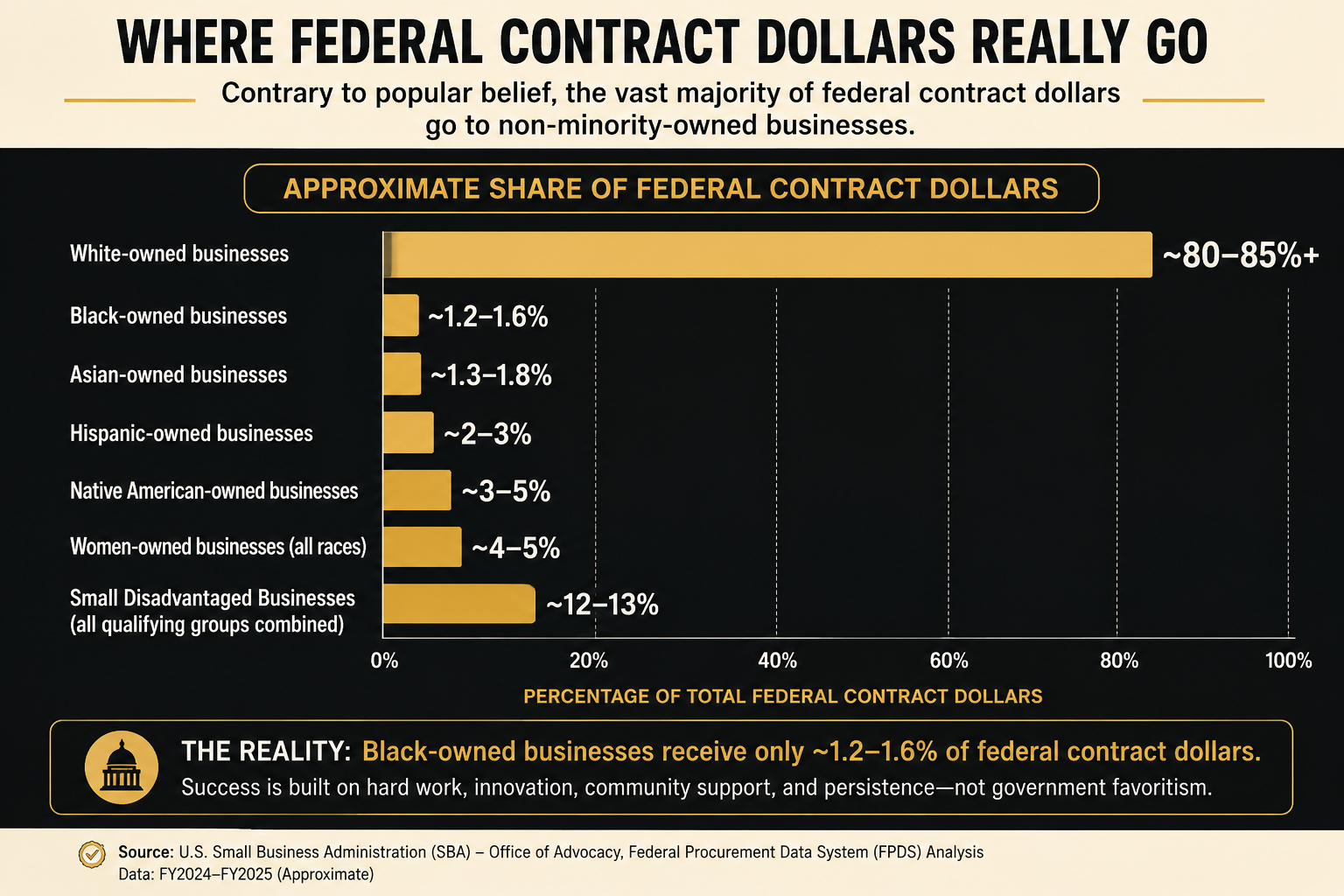
Myth: Black businesses are only successful due to diversity programs or government assistance.Truth: The real story reveals a very different reality. Most Black-owned businesses are built through personal sacrifice, long hours, community trust, skill, innovation, and relentless persistence, and not through special programs. Federal diversity contracting is often misunderstood. Critics argue that Black businesses benefit the most from these initiatives, but the data shows otherwise: Black-owned businesses receive approximately 1.6% of all federal contracting dollars, including those focused on diversity.
Out of the $133 billion allocated for "diversity" or small-business contracting, Black businesses receive only a tiny fraction, while the majority of the funds go to firms owned by White women, Asians, Hispanics, and Native Americans. This indicates that the notion that Black businesses are “propped up” by diversity, equity, and inclusion (DEI) initiatives or government assistance is not only misleading but also mathematically impossible.
Black entrepreneurs achieve success because they work harder, innovate more, and strategize effectively in systems that were never designed for them. Their success is earned, not given.
Myth: Black-owned businesses cannot compete with larger mainstream companies.Truth: Black-owned businesses compete and succeed every day across various sectors, including technology, construction, healthcare, finance, logistics, consulting, retail, and professional services. The data reveals a compelling story:Black-owned firms generate over $200 billion in annual revenue, operate in more than 90% of U.S. industries, and employ over 1.8 million Americans.
From billion-dollar tech giants like World Wide Technology to rapidly growing companies in infrastructure, medical services, and e-commerce, we black entrepreneurs are not just bystanders. We are actively shaping markets, driving innovation, and exceeding expectations. This is not merely symbolic participation; it represents real, measurable economic power.
Myth: Black entrepreneurs lack business knowledge or financial literacy.Truth: Many Black entrepreneurs are highly educated, experienced, and well-prepared to lead competitive businesses. Across the country, Black founders hold degrees in fields such as business, engineering, finance, law, healthcare, and technology. Additionally, thousands of them are certified in project management, accounting, contracting, and various industry-specific specialties.
Data from the U.S. Census and the Kauffman Foundation indicates that Black entrepreneurs are more likely to seek business training, financial education, and professional development due to stricter lending standards and higher barriers to capital. Their success is not accidental or uninformed; it stems from expertise, preparation, and a determination to excel in systems that often demand more from them than from others.
Myth: Black-owned businesses do not provide the same level of customer service.Truth: The quality of customer service is determined by leadership, training, systems, and resources, rather than by the owner's race. Many Black-owned businesses have built loyal customer bases, received five-star reviews, and established strong reputations by prioritizing professionalism, responsiveness, and community trust.
Research from the Harvard Business Review shows that perceptions of customer service are often influenced by bias rather than actual performance. As a result, Black-owned businesses are frequently judged more harshly, even when they provide equal or superior service.
In various industries, including retail, hospitality, healthcare, consulting, and technology, Black-owned companies consistently demonstrate excellence, retain repeat customers, and maintain the same service standards as any other business. The truth is clear: exceptional service depends on the business itself, not the race of its owner.
Myth: Black businesses are concentrated only in low-income neighborhoods.Truth: Black-owned businesses thrive in a variety of economic environments, including suburbs, downtown districts, commercial corridors, online marketplaces, corporate supply chains, and even international markets. Data from the U.S. Census indicates that Black-owned employer firms operate in all 50 states, with significant concentrations in thriving metropolitan areas such as Atlanta, Houston, Washington D.C., Dallas, Charlotte, and Los Angeles. Many of these Black-owned companies serve national clients, ship products worldwide, and participate in global e-commerce platforms.
Others are integrated into corporate supply chains, providing technology, logistics, consulting, construction, healthcare, and professional services to Fortune 500 companies. The notion that Black businesses are limited to struggling neighborhoods is outdated and inaccurate. The reality is that Black entrepreneurship is geographically diverse, economically dynamic, and globally connected.
Myth: There are not enough Black-owned businesses to make a meaningful economic impact.Truth: Black-owned businesses are a significant economic force that creates jobs, generates revenue, circulates money locally, and strengthens communities across the United States.
In 2023, Black-owned employer businesses generated approximately $249 billion in revenue, supported more than 1.8 million jobs, and paid nearly $70 billion in wages. These businesses operate in nearly every major sector of the economy, including technology, healthcare, construction, transportation, retail, manufacturing, and professional services. Their impact goes beyond just the business owners; they help families build financial stability and create opportunities for workers and communities alike.
Moreover, Black-owned businesses play a crucial role in local economic development. They pay taxes, support public services, hire local workers, and help keep money circulating within the communities they serve. Research from the Brookings Institution has shown that communities with a higher rate of Black business ownership often experience greater economic mobility, improved well-being, and stronger long-term economic outcomes.
The idea that Black-owned businesses lack economic impact is simply untrue. Their contributions are measurable, significant, and continue to grow. Black entrepreneurship is not a small part of the American economy; it is a vital engine of innovation, job creation, wealth building, and community development.
Myth: Black-owned businesses do not hire diverse employees.Truth: Black-owned businesses focus on hiring based on skills, experience, availability, and organizational needs rather than race. Research shows that these companies are often more diverse than the national average. They serve a wide range of markets, operate in mixed communities, and compete in industries that require a variety of talents. Studies by the Kauffman Foundation and the Brookings Institution indicate that Black-owned firms employ individuals from all racial and ethnic backgrounds, including White, Latino, Asian, and multiracial employees.
Furthermore, many Black-owned businesses participate in corporate supply chains, government contracting, and professional services—industries where diverse staffing is essential for growth and compliance. In short, Black-owned businesses build their teams like any successful enterprise, selecting the best candidates to help them grow, serve customers, and compete effectively in the marketplace. Diversity is a strength, not a barrier, and Black-owned firms exemplify this principle every day.
Myth: Black businesses are mostly side hustles and not serious enterprises.Truth: Many Black-owned businesses operate as full-time, professionally run companies that adhere to the same structural, compliance, and operational standards as any legitimate enterprise. Across the country, Black entrepreneurs manage businesses with licenses, employees, payroll systems, insurance policies, commercial leases, legal teams, accountants, HR departments, and multi-year growth plans. Data from the U.S. Census reveals that Black-owned employer firms, which have paid staff, generate over $249 billion annually and employ more than 1.8 million workers. This demonstrates that these businesses are not mere hobby projects, but fully functioning economic engines.
Furthermore, many Black-owned companies secure corporate contracts, government contracts, venture capital, and international clients, showcasing the scale and seriousness of their operations. The notion that Black businesses are “just side hustles” overlooks the reality: Black entrepreneurs are building sophisticated, compliant, and competitive enterprises that drive job creation, innovation, and economic growth nationwide.
Myth: Black entrepreneurs do not collaborate or support each other.Truth: Black entrepreneurs consistently build strong networks, partnerships, and ecosystems that enhance business growth and community wealth. Across the country, Black founders are actively involved in chambers of commerce, business associations, mastermind groups, mentorship circles, referral networks, incubators, accelerators, and vendor collaborations. These connections help them access valuable resources, capital, and opportunities.
Research from the Kauffman Foundation indicates that Black entrepreneurs are among the most likely to engage in peer-to-peer learning and community-based business development programs. Organizations such as the U.S. Black Chambers, the National Black MBA Association, the Black Women’s Business Collective, and local minority business leagues offer training, networking, and supplier-diversity pipelines that connect Black-owned businesses with corporate and government contracts.
From co-marketing partnerships to shared workspaces, joint ventures, and cross-industry collaborations, Black entrepreneurs actively support one another, building ecosystems designed for long-term success. The notion that Black businesses operate in isolation is outdated; in reality, there is a thriving culture of connection, cooperation, and collective economic power.
Myth: Black-owned businesses are not worthy of investment.Truth: Investment worthiness is not based on race but on factors like leadership, market demand, revenue potential, operational systems, and growth strategy. Black-owned businesses meet these criteria and are often led by highly qualified individuals with advanced degrees and extensive experience.
According to the Kauffman Foundation, Black entrepreneurs frequently seek formal business training and financial education due to stricter lending standards and higher barriers to capital. Despite receiving less than 2% of venture capital funding, Black-owned companies thrive in various sectors, demonstrating that the funding gap results from systemic bias, not a lack of capability.
When evaluated on key metrics like traction, revenue, and scalability, Black-owned businesses are equally investment-ready. The perception that they are "not worthy" is misleading;
Myth: Black businesses are less likely to use modern technology or e-commerce.Truth: Black entrepreneurs are actively participating in the digital economy by building websites, launching apps, accepting digital payments, running online stores, automating operations, and using AI tools to scale their businesses.
Data from the U.S. Census and the Kauffman Foundation shows that Black-owned businesses are among the fastest-growing adopters of e-commerce, mobile payments, and digital marketing. Many Black founders operate companies entirely online, selling products through platforms like Shopify, Etsy, Amazon, and their own custom sites. Others utilize automation, customer relationship management (CRM) systems, cloud software, scheduling apps, accounting tools, and AI-powered marketing to streamline their operations and compete on a national level.
Social media has also become a significant driver of growth. Black entrepreneurs lead some of the most successful communities on Instagram, TikTok, Facebook, and YouTube, employing content strategies and digital branding to reach millions of users.
The notion that Black businesses are "behind" in technology is outdated and inaccurate. In reality, Black entrepreneurs are innovators, early adopters, and digital leaders, leveraging modern tools to expand their reach, increase revenue, and build scalable, tech-forward enterprises.
Myth: Black-owned businesses cannot scale nationally or internationally.Truth: The ability to scale a business is not determined by race; it relies on factors such as capital, infrastructure, distribution, marketing, leadership, and opportunity. Black-owned businesses across the country are already demonstrating this capacity by expanding into national retail chains, securing corporate and government contracts, exporting products, and serving global clients. Companies like World Wide Technology, Blavity, Partake Foods, Mielle Organics, and The Lip Bar have evolved from local startups into national and international brands through effective operations, strategic partnerships, and market demand.
Data from the U.S. Census and the Minority Business Development Agency indicates that Black-owned employer firms operate in over 90% of U.S. industries, many of which have multi-state footprints, online distribution channels, and international customer bases. Scaling a business is about having the right systems, strategies, and resources, and Black entrepreneurs are successfully building companies that encompass all three. The myth that race determines a business's ability to scale is not only incorrect; it also overlooks the reality that Black-owned businesses are competing and expanding on a global stage.
Myth: Supporting Black businesses means excluding everyone else.Truth: Supporting Black-owned businesses is essential for promoting inclusion, fairness, visibility, and economic participation. This initiative is not about excluding others. By choosing to support Black entrepreneurs, we help communities that have historically faced underfunding, neglect, or exclusion from mainstream economic systems gain equal access to opportunities. This support not only strengthens local economies but also expands consumer choices and helps close long-standing wealth gaps affecting entire regions.
Research from the Brookings Institution and McKinsey shows that the growth of Black businesses leads to increased job creation, expanded tax bases, and greater economic mobility for all residents—not just those within Black communities. Supporting Black-owned businesses does not detract from others; instead, it levels the playing field so that talent, innovation, and hard work are recognized wherever they exist. Inclusion is not a form of exclusion; it is crucial for fostering healthy economic growth.
Myth: Black-owned businesses only exist in barbering, beauty, food, or entertainment.Truth: Black entrepreneurs are active in a diverse range of high-skill, high-impact industries, including law, medicine, finance, cybersecurity, construction, education, engineering, real estate, logistics, manufacturing, technology, and many others. The data clearly supports this.
According to the U.S. Census, Black-owned businesses are deeply integrated into nearly every sector of the U.S. economy, operating in over 90% of all industries. This includes some of the most competitive and technical fields. You can find Black-owned law firms handling corporate litigation, Black physicians managing medical practices and clinics, Black engineers leading infrastructure and design firms, and Black cybersecurity companies safeguarding government and enterprise systems.
Black-owned construction firms secure multimillion-dollar contracts, while Black logistics companies oversee fleets, warehouses, and national distribution networks. Black real estate developers are involved in building both residential and commercial projects, and Black tech companies are at the forefront of innovation in AI, SaaS, fintech, and cloud services.
The notion that Black businesses are confined to a few consumer-facing industries is outdated and inaccurate. In reality, Black entrepreneurs are builders, innovators, problem-solvers, and leaders in every major sector. They are shaping industries, driving economic growth, and expanding possibilities for the next generation.
Myth: Black businesses charge more for the same products or services.Truth: Pricing is not influenced by race; rather, it is determined by factors such as rent, labor, materials, supplier access, production costs, shipping, insurance, and the scale of the business.
Black-owned businesses often face higher operating costs because they are less likely to benefit from large-scale supplier discounts, low-interest loans, or the bulk-buying advantages that larger corporations enjoy. Research conducted by the Federal Reserve and the Brookings Institution indicates that Black entrepreneurs frequently pay higher interest rates, receive smaller loans, and have less access to wholesale pricing. These disadvantages directly impact the final prices of their goods and services.
Despite these challenges, many Black-owned businesses manage to keep their prices competitive by leveraging technology, sourcing locally, and maintaining lean operations.
The notion that Black businesses "charge more" overlooks the economic realities of running a small business. Pricing is influenced by overhead costs, supply chains, and market conditions—not the owner's race. When Black-owned businesses have equal access to capital, suppliers, and scale, their pricing becomes comparable to that of the broader market. Ultimately, the truth is clear: cost structure drives prices, not identity.
Myth: Black entrepreneurs lack innovation and do not create new products or solutions.Truth: Black innovation is thriving and transforming various industries through technology, health, finance, culture, design, education, and community-based problem-solving. Black founders are establishing tech startups that create apps, AI tools, fintech platforms, and cybersecurity solutions. They are introducing healthcare innovations that enhance access, improve diagnostics, and lead to better patient outcomes. In finance, Black entrepreneurs are developing fintech products that expand credit, streamline payments, and help close wealth gaps.
In the realms of culture and design, they are setting global trends in fashion, media, beauty, and digital storytelling. In education, they are building ed-tech solutions that promote learning, literacy, and workforce development. Additionally, Black innovators are tackling real-world challenges within communities by focusing on sustainability, food systems, transportation, housing, and civic technology.
The notion that Black entrepreneurs lack innovation is misleading; Blacks are inventors, creators, disruptors, and visionaries whose ideas drive progress and shape the future.
Myth: There are not enough qualified Black professionals to support major corporate contracts.Truth: There are Black professionals in various fields, including law, engineering, architecture, accounting, consulting, development, project management, and executive leadership, who are fully qualified to handle large-scale corporate and government contracts—and they do so every day.
These professionals are deeply involved in sectors such as cybersecurity, finance, construction management, IT, logistics, healthcare administration, architecture, data science, and enterprise consulting. Many possess advanced degrees, industry certifications, federal clearances, and decades of experience managing multimillion-dollar projects.
Organizations like the National Society of Black Engineers, the National Black MBA Association, the National Bar Association, the National Organization of Minority Architects, and the U.S. Black Chambers represent thousands of highly qualified individuals who already support Fortune 500 companies, federal agencies, and global enterprises.
Myth: Black-owned businesses do not generate significant employment opportunities.Truth: Black-owned businesses play a crucial role in job creation, workforce development, household support, and strengthening local economies, and data supports this assertion.
According to the U.S. Census, Black-owned employer firms collectively employ over 1.8 million people across the United States. These businesses offer jobs in various sectors, including professional services, healthcare, construction, technology, logistics, retail, education, and hospitality. Many Black-owned companies also provide on-the-job training, apprenticeships, internships, and skill-building programs that help workers advance to higher-paying roles.
In addition to direct employment, Black-owned businesses support entire households by providing stable income, benefits, and long-term career opportunities. They contribute to the strength of local communities through tax payments, leasing commercial spaces, contracting with other vendors, and circulating dollars within their neighborhoods at higher rates than large corporations. Research from the Brookings Institution indicates that as Black businesses grow, local employment increases, poverty decreases, and economic mobility improves for all residents—not just those in the Black community.
The notion that Black-owned businesses do not create meaningful employment is simply untrue. They are essential job creators, workforce developers, and economic stabilizers, playing a vital role in the health and growth of local and regional economies.
Myth: Consumers have to sacrifice quality to support Black-owned businesses.Truth: Quality is determined by skill, systems, standards, leadership, and accountability, not by the race of the business owner. Black-owned businesses deliver high-quality products and services because they invest in professional training, industry certifications, quality control systems, customer service standards, and continuous improvement processes. Many operate with the same or even higher levels of rigor as mainstream competitors, utilizing modern technology, documented procedures, supplier vetting, performance metrics, and customer feedback loops to maintain excellence.
Research from the Brookings Institution and Harvard Business Review indicates that consumer perceptions of quality are often influenced by bias rather than actual performance. As a result, Black-owned businesses are sometimes judged more harshly, despite meeting or exceeding industry standards.
In sectors such as engineering, healthcare, technology, construction, professional services, and retail, Black entrepreneurs consistently demonstrate craftsmanship, precision, and reliability. Quality is a function of expertise, process, and commitment, and Black-owned businesses bring all three to the table.
The truth is simple: supporting Black-owned businesses does not mean lowering expectations; it means recognizing excellence where it already exists.
Myth: Black businesses are a social cause rather than legitimate businesses.Truth: Black-owned businesses are legitimate, competitive, and professionally run enterprises. Supporting them is a matter of commerce, investment, and participation in a stronger economy, not charity.
These businesses operate under the same structures and standards as any other company. They have business licenses, payroll systems, insurance, compliance mechanisms, accounting, legal teams, human resources processes, marketing strategies, and multi-year growth plans. They compete in various industries, including technology, construction, healthcare, finance, engineering, logistics, real estate, and professional services. Many of these businesses secure corporate contracts, government contracts, venture capital, and national distribution deals, demonstrating their operational maturity and market demand.
Labeling Black-owned businesses as a "social cause" diminishes their expertise, innovation, and economic contributions. Supporting them is no different from choosing any other business; you are purchasing value, quality, and service. When Black-owned businesses succeed, local economies strengthen, jobs increase, tax bases expand, and economic mobility improves for entire communities.
Supporting Black-owned businesses is not charity; it is smart economics, inclusive commerce, and a direct investment in a more competitive and equitable marketplace.
Why These Myths Persist
These myths continue because visibility has not been equal. Many Black-owned businesses do not receive the same media coverage, funding access, corporate introductions, or marketing reach as larger mainstream competitors.
When success stories are not seen, stereotypes fill the silence. That is why platforms like JAMii matter. We are not just listing businesses. We are helping correct the record.
References and Footnotes
- U.S. Census Bureau, Annual Business Survey: business ownership, employer firms, receipts, payroll, and employment by race and ethnicity.
- U.S. Small Business Administration, Office of Advocacy: small business profiles and research on entrepreneurship and job creation.
- Brookings Institution: research on Black-owned businesses, business density, access to capital, and entrepreneurship geography.
- Federal Reserve Banks, Small Business Credit Survey: research on financing challenges, credit access, and capital gaps.
- McKinsey & Company: research on inclusive growth and economic opportunity connected to closing racial wealth and business gaps.
- National Minority Supplier Development Council: supplier diversity research on minority business enterprises and corporate procurement.
- Kauffman Foundation: entrepreneurship research on startup growth, business formation, and entrepreneurial resources.
- U.S. Black Chambers, Inc.: reports and advocacy on Black business development, capital access, and business ecosystems.
- Download Myth Busting References (PDF)
Footnote: This article is an editorial feature for JAMii’s “Our Story” series. Its purpose is to challenge common stereotypes and false narratives using public research, business trends, and the lived reality of Black entrepreneurs. Specific performance varies by business, industry, market, and access to resources.
Read More From Our Story
JAMii exists to help people discover minority-owned businesses, increase visibility, and strengthen communities through economic support.
TOGETHER IS HOW WE WIN.
Visit Our Story